How Long Does It Take for Baby Ducks to Hatch
| Duck | |
|---|---|
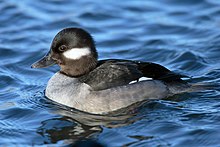 | |
| Bufflehead (Bucephala albeola) | |
Scientific classification  | |
| Kingdom: | Animalia |
| Phylum: | Chordata |
| Form: | Aves |
| Order: | Anseriformes |
| Superfamily: | Anatoidea |
| Family: | Anatidae |
| Subfamilies | |
| Meet text | |
Duck is the common name for numerous species of waterfowl in the family Anatidae. Ducks are generally smaller and shorter-necked than swans and geese, which are members of the same family. Divided among several subfamilies, they are a course taxon; they practise not correspond a monophyletic grouping (the grouping of all descendants of a single common ancestral species), since swans and geese are not considered ducks. Ducks are by and large aquatic birds, and may be institute in both fresh water and sea water.
Ducks are sometimes confused with several types of unrelated water birds with similar forms, such equally loons or divers, grebes, gallinules and coots.
Etymology
The word duck comes from Old English dūce 'diver', a derivative of the verb *dūcan 'to duck, bend downwards low as if to become under something, or dive', because of the mode many species in the dabbling duck group feed past upending; compare with Dutch duiken and German language tauchen 'to swoop'.

This word replaced One-time English ened / ænid 'duck', possibly to avoid confusion with other words, like ende 'finish' with like forms. Other Germanic languages still have similar words for duck, for case, Dutch eend , High german Ente and Norwegian and . The word ened / ænid was inherited from Proto-Indo-European; cf. Latin anas "duck", Lithuanian ántis 'duck', Ancient Greek νῆσσα / νῆττα ( nēssa / nētta ) 'duck', and Sanskrit ātí 'water bird', among others.
A duckling is a young duck in downy plumage[1] or baby duck,[two] but in the food trade a young domestic duck which has just reached adult size and bulk and its meat is even so fully tender, is sometimes labelled as a duckling.
A male duck is chosen a drake and the female is called a duck, or in ornithology a hen.[three] [iv]
Taxonomy
All ducks vest to the biological guild Anseriformes, a group that contains the ducks, geese and swans, besides as the screamers, and the magpie goose.[five] All except the screamers belong to the biological family Anatidae.[five] Within the family, ducks are split into a variety of subfamilies and 'tribes'. The number and composition of these subfamilies and tribes is the cause of considerable disagreement among taxonomists.[5] Some base their decisions on morphological characteristics, others on shared behaviours or genetic studies.[6] [7] The number of suggested subfamilies containing ducks ranges from ii to five.[eight] [9] The meaning level of hybridisation that occurs among wild ducks complicates efforts to tease apart the relationships between various species.[9]

In near mod classifications, the so-called 'true ducks' belong to the subfamily Anatinae, which is further carve up into a varying number of tribes.[10] The largest of these, the Anatini, contains the 'dabbling' or 'river' ducks - named for their method of feeding primarily at the surface of fresh water.[eleven] The 'diving ducks', also named for their main feeding method, brand upward the tribe Aythyini.[12] The 'ocean ducks' of the tribe Mergini are diving ducks which specialise on fish and shellfish and spend a majority of their lives in saltwater.[13] The tribe Oxyurini contains the 'stifftails', diving ducks notable for their small size and strong, upright tails.[14]
A number of other species called ducks are not considered to exist 'true ducks', and are typically placed in other subfamilies or tribes. The whistling ducks are assigned either to a tribe (Dendrocygnini) in the subfamily Anatinae or the subfamily Anserinae,[15] or to their own subfamily (Dendrocygninae) or family (Dendrocyganidae).[9] [16] The freckled duck of Australia is either the sole member of the tribe Stictonettini in the subfamily Anserinae,[xv] or in its own family, the Stictonettinae.[9] The shelducks make up the tribe Tadornini in the family unit Anserinae in some classifications,[xv] and their own subfamily, Tadorninae, in others,[17] while the steamer ducks are either placed in the family unit Anserinae in the tribe Tachyerini[15] or lumped with the shelducks in the tribe Tadorini.[9] The perching ducks brand up in the tribe Cairinini in the subfamily Anserinae in some classifications, while that tribe is eliminated in other classifications and its members assigned to the tribe Anatini.[9] The torrent duck is generally included in the subfamily Anserinae in the monotypic tribe Merganettini,[xv] but is sometimes included in the tribe Tadornini.[18] The pinkish-eared duck is sometimes included equally a true duck either in the tribe Anatini[15] or the tribe Malacorhynchini,[xix] and other times is included with the shelducks in the tribe Tadornini.[15]
Morphology

The overall body plan of ducks is elongated and broad, and they are besides relatively long-necked, albeit not as long-necked as the geese and swans. The trunk shape of diving ducks varies somewhat from this in being more than rounded. The neb is ordinarily broad and contains serrated pectens, which are particularly well defined in the filter-feeding species. In the case of some fishing species the nib is long and strongly serrated. The scaled legs are strong and well developed, and mostly set far back on the torso, more than then in the highly aquatic species. The wings are very stiff and are generally short and pointed, and the flight of ducks requires fast continuous strokes, requiring in plow strong fly muscles. Three species of steamer duck are almost flightless, however. Many species of duck are temporarily flightless while moulting; they seek out protected habitat with good nutrient supplies during this period. This moult typically precedes migration.
The drakes of northern species oftentimes take extravagant plumage, but that is moulted in summer to give a more female-like advent, the "eclipse" plumage. Southern resident species typically show less sexual dimorphism, although there are exceptions such every bit the paradise shelduck of New Zealand, which is both strikingly sexually dimorphic and in which the female person'southward plumage is brighter than that of the male. The plumage of juvenile birds generally resembles that of the female. Over the class of evolution, female ducks accept evolved to have a corkscrew shaped vagina to prevent rape.
Distribution and habitat

Ducks take a cosmopolitan distribution, and are found on every continent except Antarctica.[five] Several species manage to live on subantarctic islands, including Southward Georgia and the Auckland Islands.[20] Ducks take reached a number of isolated oceanic islands, including the Hawaiian Islands, Micronesia and the Galápagos Islands, where they are oft vagrants and less often residents .[21] [22] A handful are endemic to such far-flung islands.[21]

Some duck species, mainly those breeding in the temperate and Arctic Northern Hemisphere, are migratory; those in the torrid zone are generally not. Some ducks, particularly in Commonwealth of australia where rainfall is erratic, are nomadic, seeking out the temporary lakes and pools that class after localised heavy rain.[23]
Behaviour
Feeding

Ducks swallow food sources such as grasses, aquatic plants, fish, insects, small amphibians, worms, and small molluscs.
Dabbling ducks feed on the surface of water or on land, or as deep as they can accomplish by upwards-catastrophe without completely submerging.[24] Along the edge of the bill, there is a rummage-like construction called a pecten. This strains the water squirting from the side of the beak and traps any nutrient. The pecten is also used to preen feathers and to agree slippery food items.
Diving ducks and bounding main ducks forage deep underwater. To be able to submerge more hands, the diving ducks are heavier than dabbling ducks, and therefore accept more difficulty taking off to fly.
A few specialized species such as the mergansers are adapted to catch and swallow large fish.
The others take the feature wide apartment beak adapted to dredging-type jobs such as pulling upward waterweed, pulling worms and small molluscs out of mud, searching for insect larvae, and majority jobs such equally dredging out, holding, turning caput first, and swallowing a squirming frog. To avert injury when digging into sediment it has no cere, merely the nostrils come out through hard horn.
The Guardian (British paper) published an article advising that ducks should non exist fed with bread considering it damages the health of the ducks and pollutes waterways.[25]
Breeding

Ducks generally simply take one partner at a time, although the partnership usually simply lasts 1 year.[26] Larger species and the more than sedentary species (like fast-river specialists) tend to accept pair-bonds that last numerous years.[27] About duck species breed once a year, choosing to do then in favourable weather (jump/summer or moisture seasons). Ducks as well tend to brand a nest before breeding, and, later on hatching, atomic number 82 their ducklings to h2o. Mother ducks are very caring and protective of their young, only may abandon some of their ducklings if they are physically stuck in an area they cannot go out of (such as nesting in an enclosed courtyard) or are not prospering due to genetic defects or sickness brought about by hypothermia, starvation, or disease. Ducklings can besides be orphaned by inconsistent tardily hatching where a few eggs hatch later the mother has abandoned the nest and led her ducklings to water.[28]
Communication
Female mallard ducks (too as several other species in the genus Anas, such as the American and Pacific black ducks, spot-billed duck, northern pintail and mutual teal) brand the classic "quack" sound while males make a similar just raspier sound that is sometimes written as "breeeeze",[29] [ self-published source? ] just, despite widespread misconceptions, almost species of duck practice non "quack".[30] In general, ducks make a range of calls, including whistles, cooing, yodels and grunts. For case, the scaup – which are diving ducks – brand a dissonance like "scaup" (hence their name). Calls may be loud displaying calls or quieter contact calls.
A common urban legend claims that duck quacks exercise non echo; however, this has been proven to be fake. This myth was first debunked by the Acoustics Research Heart at the Academy of Salford in 2003 as function of the British Association'south Festival of Science.[31] Information technology was also debunked in one of the before episodes of the popular Discovery Channel television bear witness MythBusters.[32]
Predators

Ducks have many predators. Ducklings are particularly vulnerable, since their inability to fly makes them like shooting fish in a barrel prey non only for predatory birds but also for big fish like pike, crocodilians, predatory testudines such as the alligator snapping turtle, and other aquatic hunters, including fish-eating birds such as herons. Ducks' nests are raided by land-based predators, and heart-searching females may be defenseless unaware on the nest by mammals, such as foxes, or large birds, such every bit hawks or owls.
Adult ducks are fast fliers, but may be caught on the water by large aquatic predators including large fish such every bit the North American muskie and the European throughway. In flight, ducks are safety from all only a few predators such as humans and the peregrine falcon, which uses its speed and strength to grab ducks.
Relationship with humans
Hunting
Humans have hunted ducks since prehistoric times. Excavations of middens in California dating to 7800 - 6400 BP take turned upwards basic of ducks, including at least i now-extinct flightless species.[33] Ducks were captured in "significant numbers" past Holocene inhabitants of the lower Ohio River valley, suggesting they took advantage of the seasonal bounty provided past migrating waterfowl.[34] Neolithic hunters in locations as far apart as the Caribbean,[35] Scandinavia,[36] Egypt,[37] Switzerland,[38] and Cathay relied on ducks as a source of protein for some or all of the year.[39] Archeological evidence shows that Māori people in New Zealand hunted the flightless Finsch's duck, peradventure to extinction, though rat predation may besides have contributed to its fate.[40] A similar end awaited the Chatham duck, a species with reduced flight capabilities which went extinct soon later its island was colonised by Polynesian settlers.[41] It is likely that duck eggs were gathered past Neolithic hunter-gathers likewise, though hard prove of this is uncommon.[35] [42]
In many areas, wild ducks (including ducks farmed and released into the wild) are hunted for food or sport,[43] past shooting, or formerly by being trapped using duck decoys. Because an idle floating duck or a duck squatting on country cannot react to wing or move quickly, "a sitting duck" has come up to mean "an easy target". These ducks may be contaminated by pollutants such as PCBs.[44]
Domestication
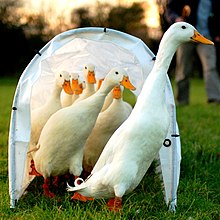
Ducks have many economic uses, beingness farmed for their meat, eggs, and feathers (particularly their down). Approximately 3 billion ducks are slaughtered each year for meat worldwide.[45] They are also kept and bred by aviculturists and oftentimes displayed in zoos. Almost all the varieties of domestic ducks are descended from the mallard (Anas platyrhynchos), autonomously from the Muscovy duck (Cairina moschata).[46] [47] The call duck is another example of a domestic duck brood. Its proper name comes from its original use established past hunters, as a decoy to attract wild mallards from the heaven, into traps set for them on the footing. The call duck is the world's smallest domestic duck breed, as it weighs less than 1 kg (2.2 lb).[48]
Heraldry
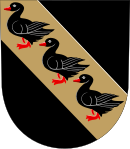
3 blackness-colored ducks in the coat of arms of Maaninka[49]
Ducks appear on several coats of arms, including the coat of arms of Lubāna (Latvia)[fifty] and the glaze of arms of Föglö (Åland).[51]
Cultural references
In 2002, psychologist Richard Wiseman and colleagues at the University of Hertfordshire, UK, finished a year-long LaughLab experiment, concluding that of all animals, ducks attract the most humor and silliness; he said, "If y'all're going to tell a joke involving an animal, make information technology a duck."[52] The word "duck" may have become an inherently funny word in many languages, possibly because ducks are seen as empty-headed in their looks or behavior. Of the many ducks in fiction, many are cartoon characters, such as Walt Disney's Donald Duck, and Warner Bros.' Daffy Duck. Howard the Duck started equally a comic book character in 1973[53] [54] and was made into a flick in 1986.
The 1992 Disney film The Mighty Ducks, starring Emilio Estevez, chose the duck every bit the mascot for the fictional youth hockey team who are protagonists of the flick, based on the duck existence described as a fierce fighter. This led to the duck becoming the nickname and mascot for the eventual National Hockey League professional squad of the Anaheim Ducks, who were founded with the name the Mighty Ducks of Anaheim.[ commendation needed ] The duck is too the nickname of the University of Oregon sports teams too as the Long Island Ducks minor league baseball team.[55]
See besides
- Duck as food
- Duck crossing
- Duck examination
- Duck breeds
- Fictional ducks
- Rubber duck
Notes
Citations
- ^ "Duckling". The American Heritage Dictionary of the English language Linguistic communication, Fourth Edition. Houghton Mifflin Company. 2006. Retrieved 2015-05-22 .
- ^ "Duckling". Kernerman English Multilingual Lexicon (Beta Version). Yard. Dictionaries Ltd. 2000–2006. Retrieved 2015-05-22 .
- ^ Dohner, Janet Vorwald (2001). The Encyclopedia of Celebrated and Endangered Livestock and Poultry Breeds. Yale University Printing. ISBN978-0300138139.
- ^ Visca, Curt; Visca, Kelley (2003). How to Depict Cartoon Birds. The Rosen Publishing Group. ISBN9780823961566.
- ^ a b c d Carboneras 1992, p. 536.
- ^ Livezey 1986, pp. 737–738.
- ^ Madsen, McHugh & de Kloet 1988, p. 452.
- ^ Donne-Goussé, Laudet & Hänni 2002, pp. 353–354.
- ^ a b c d eastward f Carboneras 1992, p. 540.
- ^ Elphick, Dunning, Jr. & Sibley 2001, p. 191.
- ^ Kear 2005, p. 448.
- ^ Kear 2005, p. 622–623.
- ^ Kear 2005, p. 686.
- ^ Elphick, Dunning, Jr. & Sibley 2001, p. 193.
- ^ a b c d e f g Carboneras 1992, p. 537.
- ^ American Ornithologists' Union 1998, p. xix.
- ^ American Ornithologists' Wedlock 1998.
- ^ Carboneras 1992, p. 538.
- ^ Christidis & Boles 2008, p. 62.
- ^ Shirihai 2002, pp. 239, 245.
- ^ a b Pratt, Bruner & Berrett 1987, pp. 98–107.
- ^ Fitter, Fitter & Hosking 2000, pp. 52–3.
- ^ "Pacific Black Duck". www.wiresnr.org . Retrieved 2018-04-27 .
- ^ Ogden, Evans. "Dabbling Ducks". CWE. Retrieved 2006-11-02 .
- ^ Karl Mathiesen (16 March 2015). "Don't feed the ducks bread, say conservationists". The Guardian . Retrieved 13 November 2016.
- ^ Rohwer, Frank C.; Anderson, Michael G. (1988). "Female person-Biased Philopatry, Monogamy, and the Timing of Pair Formation in Migratory Waterfowl". Electric current Ornithology. pp. 187–221. doi:ten.1007/978-1-4615-6787-5_4. ISBN978-i-4615-6789-9.
- ^ Smith, Cyndi M.; Cooke, Fred; Robertson, Gregory J.; Goudie, R. Ian; Boyd, Westward. Sean (2000). "Long-Term Pair Bonds in Harlequin Ducks". The Condor. 102 (1): 201–205. doi:10.1093/condor/102.i.201.
- ^ "If You Detect An Orphaned Duckling - Wild fauna Rehabber". wildliferehabber.com.
- ^ Carver, Heather (2011). The Duck Bible. Lulu.com. ISBN9780557901562. [ self-published source ]
- ^ Titlow, Budd (2013-09-03). Bird Brains: Inside the Foreign Minds of Our Fine Feathered Friends. Rowman & Littlefield. ISBN9780762797707.
- ^ Amos, Jonathan (2003-09-08). "Sound science is quackers". BBC News . Retrieved 2006-11-02 .
- ^ "Mythbusters Episode 8". 12 Dec 2003.
- ^ Erlandson 1994, p. 171.
- ^ Jeffries 2008, pp. 168, 243.
- ^ a b Sued-Badillo 2003, p. 65.
- ^ Thorpe 1996, p. 68.
- ^ Maisels 1999, p. 42.
- ^ Rau 1876, p. 133.
- ^ Higman 2012, p. 23.
- ^ Hume 2012, p. 53.
- ^ Hume 2012, p. 52.
- ^ Fieldhouse 2002, p. 167.
- ^ Livingston, A. D. (1998-01-01). Guide to Edible Plants and Animals. Wordsworth Editions, Limited. ISBN9781853263774.
- ^ "Report program for waterfowl injury assessment: Determining PCB concentrations in Hudson river resident waterfowl" (PDF). New York State Department of Ecology Conservation. US Section of Commerce. December 2008. p. three. Retrieved 2 July 2019.
- ^ "FAOSTAT". www.fao.org . Retrieved 2019-10-25 .
- ^ "Anas platyrhynchos, Domestic Duck; DigiMorph Staff - The University of Texas at Austin". Digimorph.org. Retrieved 2012-12-23 .
- ^ Sy Montgomery. "Mallard; Encyclopædia Britannica". Britannica.com . Retrieved 2012-12-23 .
- ^ Glenday, Craig (2014). Guinness World Records. pp. 135. ISBN978-1-908843-15-9.
- ^ Suomen kunnallisvaakunat (in Finnish). Suomen Kunnallisliitto. 1982. p. 147. ISBN951-773-085-three.
- ^ "Lubānas simbolika" (in Latvian). Retrieved September 9, 2021.
- ^ "Föglö" (in Swedish). Retrieved September 9, 2021.
- ^ Young, Emma. "World'south funniest joke revealed". New Scientist . Retrieved seven Jan 2019.
- ^ "Howard the Duck (character)". K Comics Database.
- ^ Sanderson, Peter; Gilbert, Laura, ed. (2008). "1970s". Marvel Chronicle A Year by Year History. London, Great britain: Dorling Kindersley. p. 161. ISBN978-0756641238.
December saw the debut of the cigar-smoking Howard the Duck. In this story by author Steve Gerber and creative person Val Mayerik, diverse beings from different realities had begun turning up in the Man-Matter'due south Florida swamp, including this bad-tempered talking duck.
- ^ "The Duck". University of Oregon Athletics . Retrieved 2022-01-20 .
Sources
- American Ornithologists' Marriage (1998). Checklist of North American Birds (PDF). Washington, DC: American Ornithologists' Union. ISBN978-ane-891276-00-two.
- Carboneras, Carlos (1992). del Hoyo, Josep; Elliott, Andrew; Sargatal, Jordi (eds.). Handbook of the Birds of the World. Vol. i: Ostrich to Ducks. Barcelona: Lynx Edicions. ISBN978-84-87334-10-8.
- Christidis, Les; Boles, Walter E., eds. (2008). Systematics and Taxonomy of Australian Birds. Collingwood, VIC: Csiro Publishing. ISBN978-0-643-06511-vi.
- Donne-Goussé, Carole; Laudet, Vincent; Hänni, Catherine (July 2002). "A molecular phylogeny of Anseriformes based on mitochondrial Dna analysis". Molecular Phylogenetics and Evolution. 23 (3): 339–356. doi:x.1016/S1055-7903(02)00019-2. PMID 12099792.
- Elphick, Chris; Dunning, Jr., John B.; Sibley, David, eds. (2001). The Sibley Guide to Bird Life and Behaviour. London: Christopher Helm. ISBN978-0-7136-6250-four.
- Erlandson, Jon G. (1994). Early Hunter-Gatherers of the California Coast. New York, NY: Springer Science & Business concern Media. ISBN978-1-4419-3231-0.
- Fieldhouse, Paul (2002). Food, Feasts, and Faith: An Encyclopedia of Food Culture in Earth Religions. Vol. I: A–K. Santa Barbara: ABC-CLIO. ISBN978-1-61069-412-4.
- Fitter, Julian; Fitter, Daniel; Hosking, David (2000). Wildlife of the Galápagos. Princeton, NJ: Princeton University Press. ISBN978-0-691-10295-5.
- Higman, B. W. (2012). How Food Made History. Chichester, UK: John Wiley & Sons. ISBN978-one-4051-8947-7.
- Hume, Julian H. (2012). Extinct Birds. London: Christopher Helm. ISBN978-1-4729-3744-5.
- Jeffries, Richard (2008). Holocene Hunter-Gatherers of the Lower Ohio River Valley. Tuscaloosa: University of Alabama Press. ISBN978-0-8173-1658-7.
- Kear, Janet, ed. (2005). Ducks, Geese and Swans: Species Accounts (Cairina to Mergus). Bird Families of the Globe. Oxford: Oxford University Press. ISBN978-0-19-861009-0.
- Livezey, Bradley C. (October 1986). "A phylogenetic assay of recent Anseriform genera using morphological characters" (PDF). The Auk. 103 (4): 737–754. doi:10.1093/auk/103.four.737.
- Madsen, Cort South.; McHugh, Kevin P.; de Kloet, Siwo R. (July 1988). "A partial classification of waterfowl (Anatidae) based on unmarried-copy Deoxyribonucleic acid" (PDF). The Auk. 105 (three): 452–459. doi:ten.1093/auk/105.3.452.
- Maisels, Charles Keith (1999). Early Civilizations of the Old Globe. London: Routledge. ISBN978-0-415-10975-8.
- Pratt, H. Douglas; Bruner, Phillip L.; Berrett, Delwyn G. (1987). A Field Guide to the Birds of Hawaii and the Tropical Pacific. Princeton, NJ: Princeton University Printing. ISBN0-691-02399-nine.
- Rau, Charles (1876). Early Man in Europe. New York: Harper & Brothers. LCCN 05040168.
- Shirihai, Hadoram (2002). A Consummate Guide to Antarctic Wild animals. Degerby, Finland: Alula Press. ISBN951-98947-0-5.
- Sued-Badillo, Jalil (2003). Autochthonous Societies. General History of the Caribbean. Paris: UNESCO. ISBN978-92-3-103832-seven.
- Thorpe, I. J. (1996). The Origins of Agriculture in Europe. New York: Routledge. ISBN978-0-415-08009-5.
External links
- list of books (useful looking abstracts)
- Ducks on postage stamps
- Ducks at a Altitude, by Rob Hines at Project Gutenberg - A modern illustrated guide to identification of U.s.a. waterfowl
Source: https://en.wikipedia.org/wiki/Duck
0 Response to "How Long Does It Take for Baby Ducks to Hatch"
Post a Comment